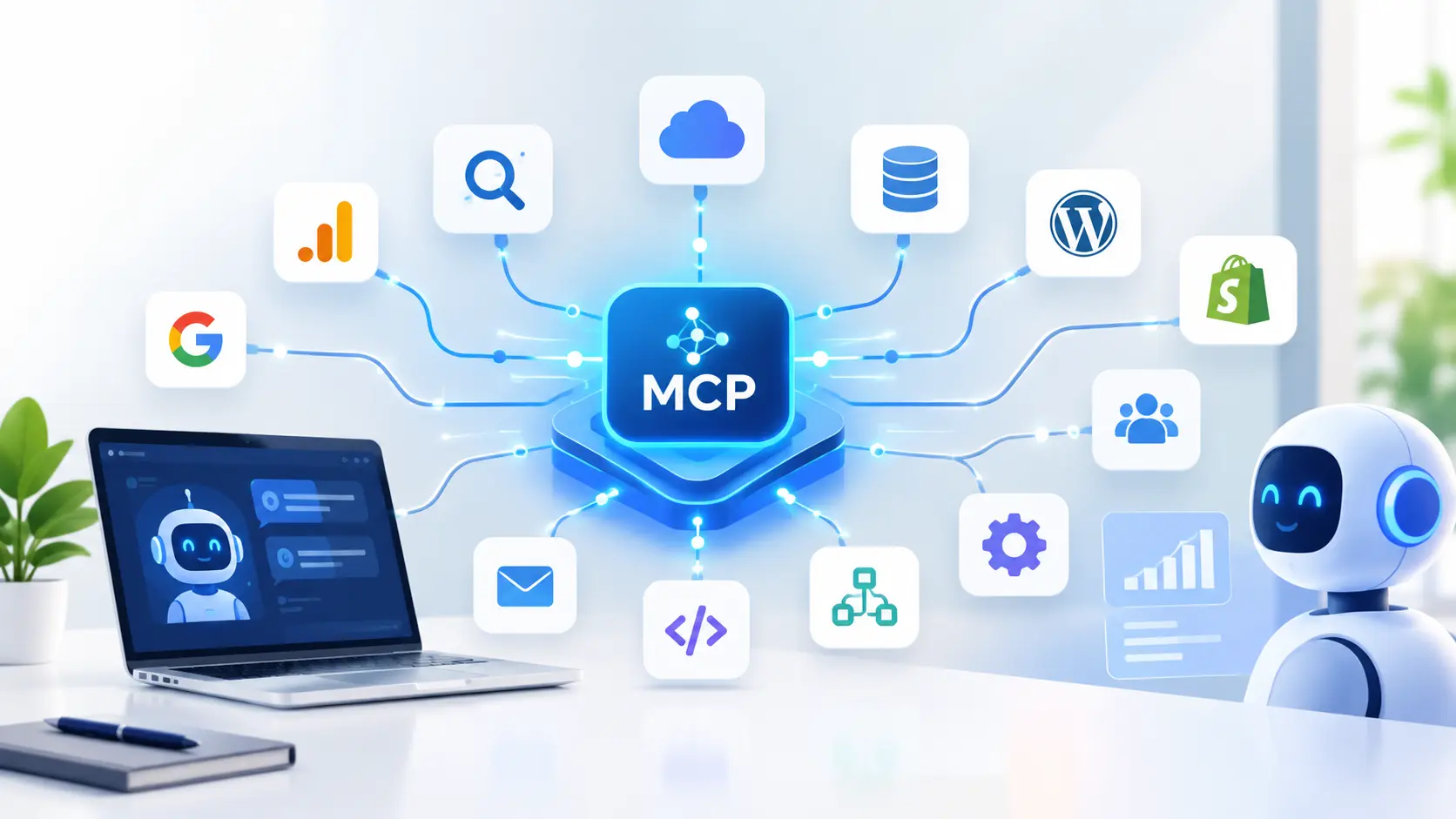
Model Context Protocol (MCP): How AI Is Changing the Way Businesses Connect Their Tools
Model Context Protocol (MCP): How AI Is Changing the Way Businesses Connect Their Tools
Most businesses do not have an AI problem. They have a plumbing problem.
The AI models available today can write, analyse, summarise, and reason at a level that would have seemed unreasonable a few years ago. But ask one of them what your organic traffic did last month, and it cannot tell you. Your traffic data sits in one platform, your rankings in another, your leads in a CRM, your content in a CMS, and your revenue figures in a spreadsheet somebody keeps renaming. The intelligence is available. The access is not.
Model Context Protocol, usually shortened to MCP, exists to fix that gap. It is an open standard that gives AI systems a consistent way to talk to the tools and data a business already uses. Instead of building a separate, fragile connection between every model and every platform, you build once against a shared protocol and everything speaks the same language.
This article covers what MCP actually is, how it works, how it differs from the API integrations you already have, and where it fits into real business workflows, including SEO and digital marketing.
What Is Model Context Protocol (MCP)?
MCP is an open protocol that standardises how AI applications connect to external systems. It was introduced by Anthropic in late 2024 and released openly, which meant other model providers, tool vendors and developers could adopt it rather than inventing their own competing versions. That is largely what happened.
Think of it as a universal port. Before USB, every device needed its own cable and its own driver. After USB, the device and the computer agreed on one interface, and everything that followed the standard just worked. MCP does the same job for AI. A model that supports MCP can connect to any tool that exposes an MCP server, without custom code written specifically for that pairing.
What gets shared through that connection falls into three categories: tools, which are actions the AI can take; resources, which are pieces of data the AI can read; and prompts, which are reusable instructions a tool can offer to guide how it should be used.
Why Is MCP Important for Businesses?
The honest answer is that it changes the economics of integration.
Without a standard, connecting five AI applications to ten business tools means building and maintaining fifty separate integrations. Every API change breaks something. Every new tool restarts the work. Most companies never get past two or three connections, which is why so many AI deployments stall at the level of a chat window that knows nothing about the business it is supposed to help.
With a standard, those same five applications and ten tools need fifteen pieces of work, not fifty. Build a connector once and any compliant AI system can use it.
There is a second benefit that matters more than it first appears. An AI model working from pasted screenshots and copied text is working from a snapshot. An AI model connected through MCP is working from live systems. It can check the current number rather than the number somebody exported on Tuesday. For reporting, monitoring, or decision support, that difference is the whole point.
How Does MCP Work?
The architecture has three parts. The host is the AI application the person actually uses. The client sits inside that host and manages connections. The server is a lightweight program that sits in front of a tool or data source and describes, in a structured format, what that tool can do.
When the host starts up, it asks each connected server what it offers. The server replies with a list of available tools and resources, along with descriptions of what each one does. The model reads that list the same way a new employee reads a list of systems they have been given access to.
From there, the flow is straightforward. Someone asks a question. The model decides which tool can answer it. It sends a structured request through the protocol. The server executes the request against the real system and returns the result. The model uses that result to answer, and can chain several calls together if the question needs more than one source.
Two things are worth being clear about. The model does not get unrestricted access to your systems — the server defines exactly what is exposed, and the surrounding application controls authentication and permissions. And the model does not go around your existing security. It works through it, using credentials that can be scoped as narrowly as you want.
MCP vs Traditional API Integrations: What's the Difference?
MCP does not replace APIs. It sits on top of them. Most MCP servers are calling ordinary REST APIs underneath.
The difference is who the interface is designed for. A traditional API is written for a developer who reads documentation, understands the data model, writes code against specific endpoints, and handles the errors. It assumes a human is doing the interpreting in advance.
An MCP server is written so the tool can describe itself at runtime. The model does not need documentation because the capabilities arrive with the connection. It does not need hardcoded logic because it can choose which tool suits the request. And the same server works with any MCP-compatible AI application, so the integration is not locked to one vendor.
In practical terms, a traditional integration answers a question somebody anticipated. An MCP integration can answer questions nobody anticipated, because the model composes the steps itself.
How Can Businesses Use MCP?
The use cases tend to look unremarkable on paper and feel significant in practice, because they remove work that nobody enjoys doing.
AI-powered data analysis: Connect a warehouse or database and ask questions in plain language. The AI writes the query, runs it, and explains the result.
Marketing automation: Pull campaign performance from ad platforms and email tools, compare it against targets, and generate the summary that would normally take an afternoon.
Customer support: Give the AI access to ticket history, product documentation and account records so replies are grounded in what is actually true for that customer.
SEO workflows: Combine crawl data, rankings and analytics in one place so issues get spotted while they still matter.
Content management: Connect the CMS so drafts, metadata updates and internal linking suggestions happen where the content lives.
Business reporting: Assemble monthly reports from several systems at once, with figures pulled live instead of retyped.
Internal productivity: Search across documents, project tools and messages to find where something was decided and why.
How MCP Can Support AI-Powered SEO
SEO is a strong fit for MCP because the work is already spread across too many platforms.
A typical audit means opening Search Console for query and indexing data, an analytics platform for behaviour and conversions, a keyword tool for volume and difficulty, a crawler for technical issues, and the CMS for the pages themselves. The analysis is not usually the hard part. The gathering is.
With those systems connected through MCP, the sequence changes. You can ask which pages lost impressions over the last quarter and have the AI pull Search Console data, cross-check it against recent publishing activity in the CMS, look at technical issues from crawl data, and return a shortlist of pages worth attention with a reason attached to each one.
The same approach applies to content planning informed by live keyword and performance data, internal linking suggestions based on the pages that actually exist, and client reporting that pulls current figures instead of month-old exports. For an agency, the value compounds — the same connected setup serves every client account, and the time saved on assembly goes back into strategy.
MCP and the Future of AI Agents
Chat assistants answer questions. Agents complete tasks. The distinction depends almost entirely on access.
An agent asked to prepare a quarterly review needs to pull the data, notice what changed, check related systems for an explanation, draft the summary and put it somewhere useful. Every one of those steps is a connection. MCP gives agents a consistent surface to operate against, which is why agent development and MCP adoption have moved together.
It also makes oversight more practical. When capabilities are declared explicitly and actions run through defined servers, you can see what an agent is allowed to touch and log what it did — something that matters a great deal once these systems handle anything consequential.
Is MCP the Future of AI Integration?
Standards win when the alternative becomes too expensive to maintain, and custom AI integrations are expensive to maintain.
MCP has the conditions that usually predict adoption. It is open rather than controlled by one vendor. It solves a problem every organisation building with AI runs into. It has support across major model providers and a large ecosystem of community-built servers. And it does not require replacing anything, since it wraps the systems already in place.
That does not make it the final answer. The specification is still maturing, particularly around authentication and enterprise governance, and the security implications of giving AI systems real access deserve serious attention. But the direction is clear enough. The question for most businesses is not whether to connect AI to their tools, but whether they do it once against a standard or repeatedly against a moving target.
Frequently Asked Questions About MCP
What is MCP in AI?
MCP is an open standard that lets AI models connect to external tools, data sources and applications through a consistent interface, so they can work with live business systems instead of relying only on what a user pastes into a conversation.
What does MCP stand for?
Model Context Protocol. The name describes its purpose — supplying AI models with the context they need from outside sources.
How does Model Context Protocol work?
An MCP server sits in front of a tool and describes what that tool can do. An AI application connects to the server, reads those capabilities, and sends structured requests when a task requires them. The server runs the request against the real system and returns the result.
Is MCP an API?
Not exactly. MCP is a protocol that standardises how AI systems discover and use capabilities, and most MCP servers call conventional APIs underneath. The difference is that MCP is designed for AI models to interpret at runtime, while APIs are designed for developers to code against in advance.
What can MCP connect to?
Databases, analytics platforms, CRMs, CMS systems, file storage, project management tools, communication platforms, search consoles, internal applications, and effectively anything with an API or a queryable data source.
Is MCP useful for businesses?
Yes, particularly for organisations running several disconnected tools. It reduces integration cost, keeps AI outputs grounded in current data, and makes automation practical for workflows that previously required manual assembly.
How can MCP support digital marketing?
By connecting analytics, advertising platforms, SEO tools, CRMs and content systems so an AI assistant can report on performance, spot changes, support content decisions and handle repetitive reporting work using live data rather than exports.
Conclusion
The gap between what AI can do and what it does for most businesses comes down to access. A model that cannot see your data can only ever give general advice. A model connected to your systems can give specific answers about your situation.
MCP matters because it makes that connection repeatable. Build against the standard once, and the work carries across tools, models and future applications instead of being rebuilt each time something changes.
For businesses still treating AI as a separate window they paste things into, this is the shift worth understanding. The organisations getting real value from AI are not necessarily using better models. They are the ones that connected theirs to the systems where the work actually happens.

PRODUCTION HOUSE
- Tapclone, House no: 32/2517A
- PJ Antony Rd,Sonia Nagar,Palarivattom,
- Kochi,Ernakulam , Kerala - 682025
- Ph: +0484 796 5300 Mob: +91 9037 833 933
KOCHI
- Tapclone, MK Arcade, Near Souvarna Library, Pallissery Road
- Palarivattom, Kochi
- Ernakulam, Kerala - 682025
- Email : info@tapclone.in
- Ph: +0484 796 5300 Mob: +91 9037 833 933
CALICUT
- Tapclone, Fortune Business Park,2nd Floor,
- Cherooty Nagar,Asokapuram,Calicut-673006
- Ph : 0495 460 5549 Mob: +91 9037 833 933